
Everything you need to sell, promote and order
personalised business Christmas cards
Christmas cards are one of the easiest sales of the year. Nearly every business sends them; most leave it until too late, and once a customer orders from you, they tend to come back next December without much convincing.
Good news ahead of the Christmas card rush: we've cut prices across our Silk, Matt Laminated, Foil and Spot UV Christmas Cards, with reductions of up to 74%.
The biggest savings are on smaller runs, which makes it far easier to win the clients who only need a couple of hundred cards for their team and top customers. A few highlights:
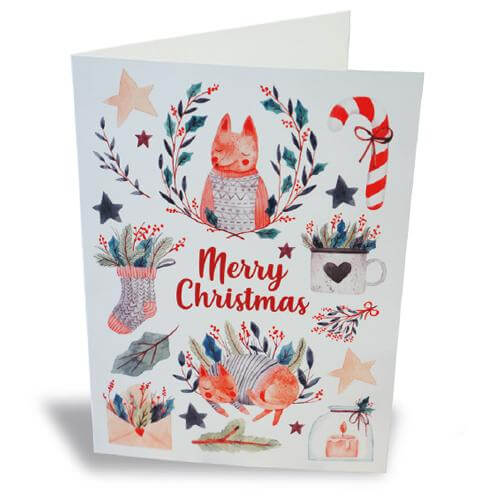
100x 350gsm Silk Large (folds to A5) for £41.31 (was £116.96) 65% less
125x 350gsm Spot UV Thin (folds to 1/3 A4) for £52.40 (was £204.00) 74% less
125x 350gsm Matt Lam Large (folds to A5) for £48.07 (was £167.26) 71% less
25x 350gsm Foiled Regular (folds to A6) for £46.90 (was £60.65) 23% less
We've also added a Mini Square size (folds to 125x125mm) and introduced short runs from as few as 10 cards, so there's no job too small.
One thing to note on Spot UV: it's now printed on 350gsm silk artboard with matt laminate and spot UV on the outside, to match the silk and so it's worth refreshing your client quotes, price lists and websites.
Plus, we've brought back 350gsm Gloss Laminated Cards at their best-ever price.
Product overview
Personalised Christmas cards for businesses, printed with the customer's own design, logo, photo or message, and supplied with optional envelopes. Most business buyers want a folded card with a designed front and a printed greeting inside, perhaps leaving space for a handwritten signature or personal line.
Key selling points
Every business is a prospect: if they have customers, they send cards.
- Built-in urgency. Posting deadlines do the closing for you. There is no "we'll think about it until March".
- A proper upgrade path. Silk stock to matt laminated, spot UV or foil. Customers happily spend more on something their clients will display on a shelf.
- Annual repeat business. Save the artwork, diarise October, and next year's order is a single email.
- A door-opener. Address labels, calendars, giveaway gifts and New Year cards all follow naturally.
Elevator pitch
"Christmas cards are the one piece of marketing your clients actually keep. We'll print yours with your logo and message inside. Order before December and they'll be with you in plenty of time for the last posting dates."
Who buys Christmas Cards?
Almost anyone can buy Christmas cards, but these four customer types are where the volume and repeat orders sit. Prioritise them in your outreach.
The Professional Services Firm
Why they buy: Accountants, solicitors, financial advisers and estate agents run on relationships. A card is a low-cost way to thank clients and stay front of mind before January, which is peak season for many of them.
Typical order: 50 to 500 cards, often with a premium finish. Very likely to repeat annually.
What they care about most: Looking polished and professional, correct spelling of partner names, and an inclusive message for a mixed client base.
Good opener: "Who do you send Christmas cards to at the moment, clients, introducers, or both?"
The Corporate Marketing Manager
Why they buy: Responsible for the company's seasonal send-out and usually juggling it alongside a dozen other year-end jobs. Wants one supplier who handles it properly.
Typical order: 250 to 1,000+ cards, sometimes split across departments or offices.
What they care about most: Brand accuracy, clear timelines and approval stages, and not having to chase anything.
Good opener: "When does your Christmas card sign-off usually happen? Let's work back from that."
The Independent Retailer or Hospitality Business
Why they buy: Cafés, salons, gift shops and restaurants use cards to thank regulars, put in customer bags, or hand to suppliers. Often combine them with gift tags or packaging.
Typical order: 50 to 250 cards, sometimes more if cards go into every bag or order.
What they care about most: Price, speed, and something that looks as good as their shop does.
Good opener: "Are you doing anything special for your regulars this Christmas?"
The Charity or Not-for-Profit
Why they buy: Cards thank donors, volunteers and supporters, and can double as a fundraising message. Some sell their own charity cards to supporters.
Typical order: 100 to 1,000 cards; sometimes a larger retail run if selling to supporters.
What they care about most: Value, a recycled or sustainable option, and a message that fits their cause.
Good opener: "Do you send anything to your donors and volunteers at Christmas?"
How to sell Christmas Cards
Qualifying questions
"How many cards did you send last year, and who organised them?"
This gives you the quantity and the decision-maker in one go.
"Who do they go to: clients, suppliers, your team, or all three?"
Different audiences can mean different messages, or a second design.
"When do you need them in your hands?"
Work back from the answer to set an order date. Most people haven't thought about it, which is your opening.
Buying signals to listen for
Any mention of year-end, client appreciation, a Christmas party or a quiet December.
"Last year we left it too late" or "we ended up buying boxed cards from the supermarket".
A new logo, rebrand or office move this year. They'll want the new look out there.
Previous orders for calendars, compliment slips or client gifts.
Handling objections
"We send e-cards now."
That's fair, and e-cards are cheap. The trouble is they're opened for three seconds, if they get past the spam filter. A printed card sits on a desk or shelf for three weeks with your name on it. Many businesses do both: a printed card for their top clients, an e-card for everyone else.
"It's too early to think about Christmas."
It feels early, but the businesses that order now get their first choice of finish and delivery date, and nobody is signing 200 cards on 18 December. Let's get the artwork sorted now and fix a delivery date that suits you.
"Not all of our clients celebrate Christmas."
Plenty of our customers go with a "Season's Greetings" or "Happy Holidays" message, or a winter design that works for everyone. We can also do New Year cards, which avoid the question altogether and arrive when inboxes are quiet.
"It's too expensive."
At [price per card], including the envelope, it costs less than the stamp going on it. And unlike most marketing, people keep it on display. If budget is tight, we can look at a smaller size or send premium cards to your top 50 clients only.
"We've left it too late."
If it's before [last order date], it isn't. If it is, New Year cards are a strong alternative: they land when there's less competition on the doormat and still say thank you.
Artwork and File Supply
Most Christmas card problems start with artwork, usually the inside of the card. If you have customers who supply their own designs, share these requirements with customers at the start, and send them the template rather than letting them guess.
| Requirement | Specification |
| File format | Print-ready PDF (Compatibility: Acrobat 5 (PDF Version 1.4) or later). |
| Bleed | 1.5mm on all edges. |
| Safe zone | Keep text and logos at least 5mm inside the trim line, and at least 5mm away from the fold. |
| Resolution | 300dpi at final size. Images copied from websites are usually 72dpi and will print blurry. |
| Colour mode | CMYK. |
| Fonts | Converted to outlines. |
| Folded layout | Supply as flat spreads: outside (back panel | front panel) and inside (inside left | inside right). Check the template for panel order. |
| Foil or Spot UV | Supplied as a separate vector layer in a spot colour named as the foil colour that you want, for example ‘Silver Foil’. For Spot UV, named exactly SPOT-UV (CMYK: 2% Cyan, 8% Magenta, 82% Yellow). All elements set to overprint. |
| Template | Download from the product pages |
Common mistakes and how to avoid them!
Front and back panels swapped. The front of a folded card sits on the right of the outside spread. Always proof against the template.
Text running into the fold. Inside messages centred across the spread end up in the crease. Keep the message on the inside right panel.
Pale inside text. Light grey or gold on white looks elegant on screen and disappears in print. Stick to strong colours for the greeting.
Misspelt names. Printed signatures and partner names get checked least and noticed most. Ask customers to have someone who didn't write the text sign off the proof.
No room to write. If the customer wants to add a handwritten line, leave space for it and recommend an uncoated stock, which takes ink without smudging.
Contrasting stripe on front of the card. When designing greeting cards with a front panel background that should touch the fold, ensure that the picture overlaps the fold by 1mm. Remember to manage your customer’s expectations that there may be part of the front design just visible on the back.
Landscape Greeting Cards
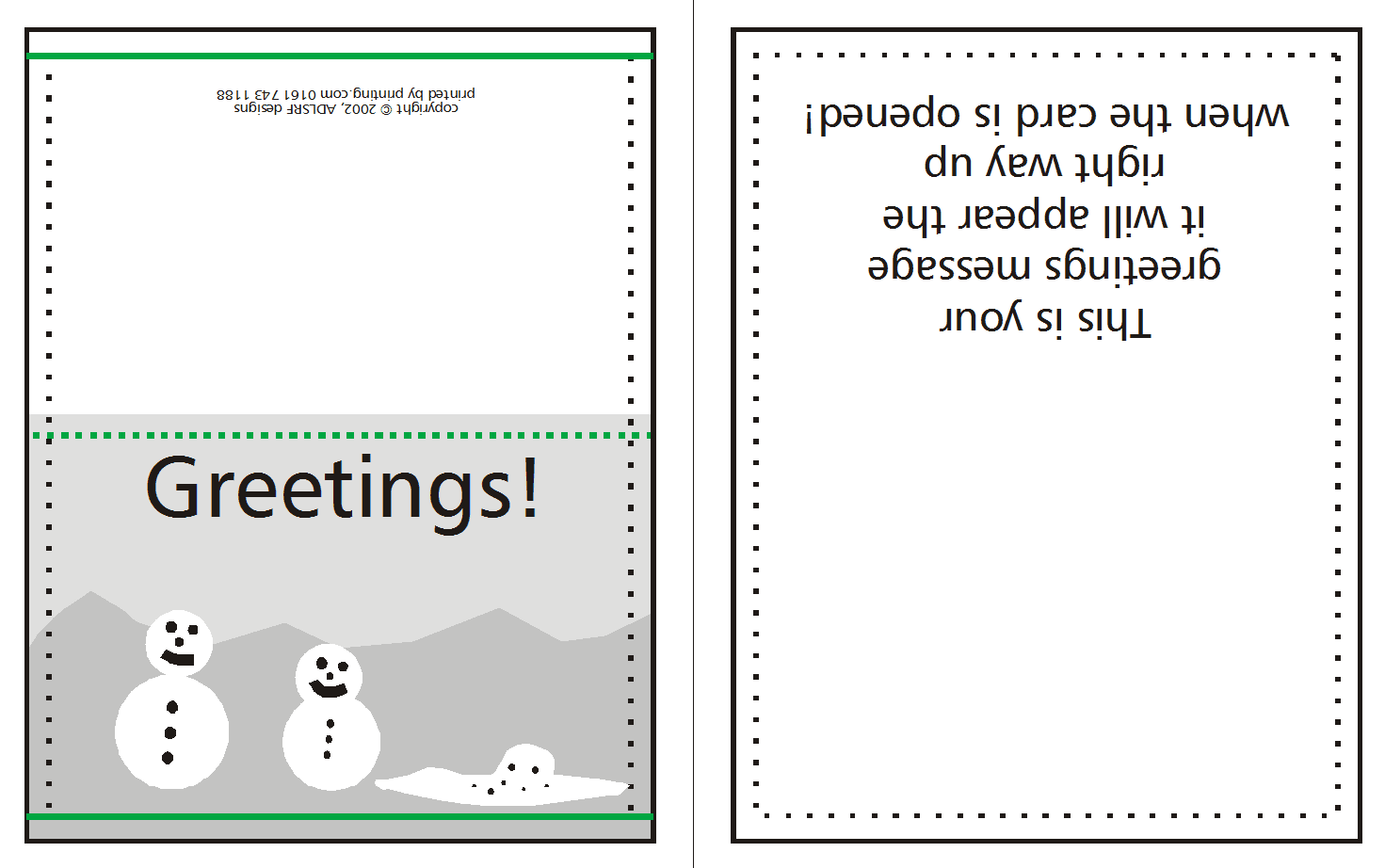
When viewed flat, the inside artwork needs to read upside-down relative to the front.
Cross-Sell & Upsell Opportunities
Christmas card buyers are already in a "sorting out December" mindset, and the artwork is ready to be applied to other products. Mention these at the quote stage, not after the order is placed.
- Address stickers
- Packaging stickers
- Wall Calendars
- Desk Calendars
- Notepads
- Notebooks
- Merch Boxes
- Branded Chocolates
- Gift Boxes
Marketing Support
Social posts
Instagram
Your clients will keep your Christmas card on the shelf for three weeks. Your email? Three seconds. Personalised business Christmas Cards, printed with your logo and message, envelopes included. Order by [date]. Link in bio. #BusinessChristmasCards #ChristmasCards #ShopLocal
LinkedIn
A quick maths problem: 200 clients, one printed Christmas card each, on display for roughly three weeks. That's a lot of desk time for your brand. We print personalised business Christmas Cards with your logo and message inside, plus envelopes and address labels if you want the whole thing sorted. Order by [date] for guaranteed delivery before the last posting dates. [Link]
Facebook
Signing 200 Christmas cards on 20 December is nobody's idea of festive. Get your business cards ordered early: your design, your message, envelopes included, and we'll help with the address labels too. Order by [date] and relax. [Link]
Creative direction
Photograph your jobs from last year. Use your own customers' cards (with permission) as social proof.
Show the cards in use: on a desk, on a shelf, stacked with addressed envelopes, rather than flat on a white background.
Flat-lay shots with envelopes, calendars and a pen sell a Christmas bundle!
What to write in a business Christmas Card
Keep it short, warm and specific to the relationship. A printed message plus one handwritten line is the sweet spot. Some ideas to adapt:
For clients
"Thank you for your business and your trust this year. Wishing you a restful Christmas and a successful New Year."
"It's been a pleasure working with you in 2026. Here's to more of the same in 2027."
For suppliers and partners
"Thank you for keeping us running smoothly all year. We couldn't do it without you."
For your team
"Thank you for everything you've put in this year. Enjoy a well-earned break."
For new clients
"We're so glad you joined us this year. Wishing you a wonderful Christmas, and we're looking forward to the year ahead together."
For mixed or international audiences
"Season's greetings and warm wishes for the year ahead."
"Wishing you peace, happiness and a brilliant New Year."
Tip: avoid sales messages inside the card. The card is the marketing.
What about signatures?
Print the signatures. Scan each person's signature and have it printed inside. Then everyone adds a short handwritten line to their own contacts only.
Run it like a production line. One person signs, one stuffs, one seals and labels. Biscuits help. Start early. A few cards a day from late November beats a two-hour marathon in mid-December.
Split by relationship. Each team member signs cards for the clients they know best. It reads more personally and spreads the load.
How much do Christmas Cards cost to post?
Royal Mail prices post by size, thickness and weight. A standard Letter can be up to 240 x 165mm, 5mm thick and 100g. Anything larger, thicker or heavier is a Large Letter and costs more to send.
Most folded A6, A5 and square cards in their envelopes fall within the Letter size. Watch out for add-ons that push the thickness past 5mm, such as enclosed gifts, chunky seals or ribbon, and very heavy card stocks. If in doubt, weigh a sample before you buy stamps for 300 of them. Check current sizes and prices on royalmail.com.
Why printed cards still beat the e-card
E-cards are quick and cheap, and they have their place. But an email sits in an inbox with a hundred others and is gone with one click. A printed card gets opened by hand, read, and put on display, often for weeks. It says you took the time, which is the whole point of saying thank you.
Many businesses get the best of both: printed cards for key clients and partners, an e-card for the wider mailing list. Either way, Nettl Systems can help, and we'll have your cards printed, packed and ready to sign by the last posting dates.
Business Christmas Cards: The Evidence
Physical Christmas cards still win: around three in four UK adults prefer a real card to a digital one, and most display every card they get. Use the figures below when your clients ask whether sending business Christmas cards is worth it. Every stat has its source, sample and date, so you can quote it with confidence.
Customers prefer real cards:
77% of people would rather receive a physical Christmas card than a digital one. Only 2% prefer digital.
89% display all the cards they are sent.
Source: OnePoll, 2,000 people who have sent or received cards
Fewer businesses send them, so yours stands out
Only 49% of UK businesses surveyed planned to send clients and suppliers a Christmas card, according to a Moneypenny survey (Censuswide, 100 business decision makers, November 2024). More planned to send an email greeting (54%). A card arriving on a quieter doormat has less competition for attention.
No UK study directly links business Christmas cards to sales or ROI, so don't claim it. The safe claim: people value, keep and display real cards, and mail from businesses earns attention and goodwill.